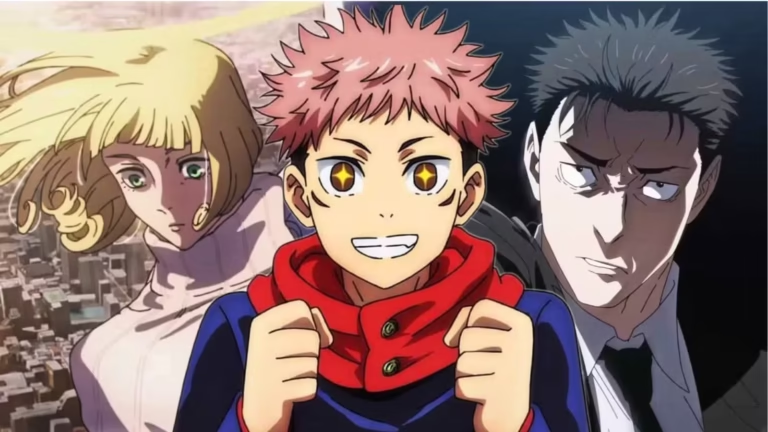
Nobody was ready for this. Not really.
We thought we were. We’d survived Shibuya. We’d watched Gojo get sealed, watched Nanami die, watched Yuji get crushed emotionally and physically in ways that felt genuinely cruel. We thought Season 2 had prepared us for whatever came next.
It did not prepare us for this.
Jujutsu Kaisen Season 3 adapts the Culling Game arc — one of the most structurally ambitious, emotionally chaotic, and narratively dense arcs in the entire manga. And MAPPA did not come to play games. They came to end careers. They came to remind every other studio what elite-level anime production looks like when a team is fully locked in.
This is a full review. Let’s break it down properly.
What Even Is the Culling Game — And Why It Hits Different
Before diving into production and character moments, it’s worth establishing what the Culling Game actually is, because the setup alone is a masterpiece of sinister game design.
Kenjaku — the ancient sorcerer who spent centuries wearing Suguru Geto’s face — has activated a barrier across Japan that forces sorcerers and awakened civilians into a death game. Players must earn points. Points are earned by killing other players. Rules can be changed by spending points. And anyone who refuses to participate dies automatically from the barrier itself.
It is one of the most ruthless conflict structures ever created in shonen manga. There’s no villain base to raid. There’s no army to defeat in a single climactic battle. The game itself is the trap, and the rules are the chains. The protagonists can’t just punch their way out of this one. They need strategy, sacrifice, and sometimes luck.
That complexity is what makes Season 3 feel different from every prior season of JJK. This isn’t a siege. This isn’t a single catastrophic event. It’s a systematic dismantling of every sense of safety the characters — and the audience — had left.
MAPPA’s Animation — They Are Not Slowing Down, and It’s Terrifying
Let’s address the elephant in the room first, because it has to be said.
After Shibuya, after everything Season 2 delivered visually, the question floating around the community was whether MAPPA could sustain that level of quality. The Culling Game arc is sprawling. Multiple battles happening across different colonies, different locations, different character pairings. Maintaining animation consistency across all of that is a genuine logistical nightmare.
And yet.
The fights in Season 3 are some of the most technically impressive sequences MAPPA has ever produced. The Hakari Kinji sequences in particular are an absolute triumph of creative visual direction — his Idle Death Gamble domain expansion is unlike anything previously depicted in the series, and the way the animation team chose to represent it visually feels genuinely inspired rather than just adapted.
Yuta Okkotsu’s appearances hit like a freight train. Every frame of him in combat carries weight. There’s a deliberateness to how the animation presents him — slower build-ups, then explosive payoffs — that communicates his power more effectively than a thousand exposition lines ever could.
And then there’s Sukuna. Because of course there is. His sequences throughout Season 3 carry the same bone-deep wrongness that made his Shibuya moments so disturbing. He doesn’t move like a sorcerer. He moves like something pretending to be human, and the animation team nails that distinction every single time.
Hakari Kinji — The Character Nobody Expected to Love This Much
Let’s talk about the breakout character of Season 3, because it isn’t who most manga readers expected to land as hard as he did.
Hakari Kinji was introduced in the manga as this swaggering, self-obsessed schemer who ran an underground fighting ring and got suspended from Jujutsu High. On paper, he sounds like a side character with edge. In execution — especially in Season 3’s adaptation — he becomes something genuinely magnetic.
His technique is built on gambling. Literally. His domain expansion runs on the logic of a pachinko jackpot system, and when he hits — when that jackpot triggers — he becomes effectively immortal for a window of time. Cursed energy regenerates faster than damage can accumulate. He can take lethal hits and walk it off like a bad Tuesday.
But the reason Hakari works as a character isn’t just the broken ability. It’s the philosophy underneath it. He gambles because he genuinely believes his own luck is reality-defying. That confidence isn’t arrogance performed for show. It reads as conviction, and Season 3’s voice performance and animation bring that conviction to life in ways the manga panels suggested but couldn’t fully deliver.
His fight against Kashimo Hajime in the Culling Game is one of the best extended combat sequences of the entire season. Two completely different combat philosophies colliding — precision and lightning versus chaos and luck — and the outcome manages to feel both earned and somehow shocking at the same time.
The Kashimo Problem — When a Villain Makes You Feel Complicated Things
Hajime Kashimo deserves his own section because he represents something Season 3 does better than most shonen at this level of popularity.
He is not redeemable. He is not secretly sympathetic in the way that softens him. Kashimo is an ancient warrior who lived hundreds of years ago, chose to be reincarnated into the Culling Game with a single purpose, and that purpose is to fight Ryomen Sukuna at full power before he dies.
That’s it. That’s the whole motivation.
And it is completely compelling.
There’s something almost poetic about a character whose entire existence in the present is pointed toward a single moment — not revenge, not justice, not survival. Just the desire to face the strongest thing that has ever existed and see what happens. Kashimo doesn’t want to win. He wants to know. He wants the experience of existing at that level of intensity.
When he finally reaches Sukuna, when that confrontation actually happens on screen, it is not the fight anyone expected. It’s shorter than the buildup suggested. It’s more brutal than even the Shibuya sequences prepared you for. And the way Sukuna responds to Kashimo — with something almost resembling respect, then absolute zero mercy — says more about what Sukuna actually is than any amount of lore exposition could.
This wasn’t just a fight. It was a statement.
Where Yuji Itadori Stands Now — And Why It Hurts
Here’s the part of the Season 3 review that requires some emotional honesty.
Yuji Itadori is no longer the center of his own story in the way he used to be.
That sounds like criticism. It isn’t. It’s actually one of the most intentional and bold narrative choices in the series, and Season 3 makes it explicit. The Culling Game splits the cast across multiple fronts. Yuji is operating in his colony while others handle theirs. He’s growing, he’s fighting, he’s surviving — but the camera keeps pulling away to show how much is happening without him.
And that’s the horror Gege Akutami has been building toward since the beginning. Yuji thought he was the protagonist in the classical sense — the boy who bears the monster inside him and fights to save people by controlling that power. But the Culling Game reveals that he’s a piece in a game he doesn’t fully understand yet, running on a board designed long before he was born.
His emotional state in Season 3 is genuinely difficult to watch. Not in a gratuitous way. In the way that good storytelling makes you uncomfortable because it’s honest. He’s processing grief that has no resolution. He’s fighting for people he can’t always save. He’s learning, slowly and painfully, that effort and good intentions don’t guarantee outcomes in this world.
That growth is quiet compared to the explosive character moments other players in the Culling Game get. But it’s the kind of growth that matters more in the long run. And Season 3’s direction understands that. It doesn’t overplay Yuji’s emotional arc. It lets it breathe underneath everything else happening.
The Pacing Question — Does Season 3 Get It Right?
No review of JJK Season 3 would be complete without addressing pacing, because the Culling Game arc in the manga had a reputation for being difficult to navigate. Multiple simultaneous plotlines, dense technique explanations, large casts across different colonies — it’s a lot.
Season 3 handles this better than expected, but not perfectly.
The early episodes do a strong job establishing the game’s rules and distributing the cast across different fronts without losing the audience. The Hakari and Yuta focus in the first half of the season gives the arc an emotional anchor to return to when the wider Culling Game mechanics start getting complex.
Where pacing stumbles slightly is in the mid-season stretches where the show needs to cover multiple colony developments simultaneously. Some of the transitional episodes feel slightly crowded — trying to service too many character beats in a single runtime without enough space for any single moment to fully breathe.
But here’s the critical thing. Even the slower episodes of JJK Season 3 are operating at a quality level that most anime would frame as peak episodes. The floor is just genuinely high. So calling out pacing issues in Season 3 feels a bit like complaining that a five-course meal had one course that was merely very good rather than extraordinary.
The Moment That Defines Season 3 — Without Spoiling It Completely
There is a sequence in the back half of Season 3 that this review will not detail fully, because experiencing it cold is the only correct way to experience it.
What can be said is this. There is a confrontation that reframes every assumption the audience had about power ceilings in Jujutsu Kaisen. There is a moment where the show stops being about the Culling Game specifically and becomes about something larger — about what cursed energy even means, about what Sukuna’s existence represents for the world, about what the characters fighting against all of this are actually up against.
It is one of the most overwhelming sequences in modern anime. The animation is doing something technically extraordinary. The score underneath it is doing something emotionally precise. And when it’s over, you will sit there in silence for a moment, because that’s the only appropriate response.
That moment is why Jujutsu Kaisen Season 3 isn’t just a good season of anime. It’s an argument. An argument that this series belongs in the conversation about the greatest shonen anime ever produced.
Final Verdict — A Season That Demands to Be Taken Seriously
Jujutsu Kaisen Season 3 is not a perfect season. The pacing occasionally buckles under the weight of its source material. Some characters who deserved more screen time get shortchanged by the sheer volume of plot happening across multiple fronts.
But perfect was never the goal. The goal was to adapt one of the most ambitious and brutal arcs in modern manga and make it hit on screen the way it hit on the page. That goal was achieved. Exceeded, in several places.
The animation is among the best in the industry right now. The character work — especially Hakari, Kashimo, Yuta, and the quietly devastating development of Yuji — is layered and thoughtful. The score elevates every key moment. And the willingness to commit to consequences, to refuse to soften the edges of a story this dark, is something that sets JJK apart from almost everything else in its genre.
Season 3 makes one thing abundantly clear. Jujutsu Kaisen is not building toward something. It is the thing. Right now. This is it.
And if you haven’t watched it yet — what exactly are you waiting for?