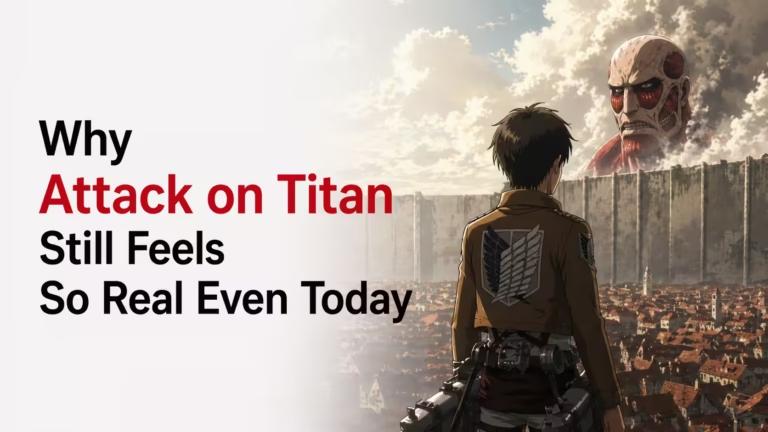
Let’s start with something that might make you slightly uncomfortable.
Attack on Titan is not about giants eating people. It never was. The Titans were always the least frightening thing in the entire series. And the moment you realize that — truly internalize it — is the moment this show stops being an anime you watched and starts being something that genuinely lives in the back of your mind.
Hajime Isayama wrote something that operates on two completely different levels simultaneously. On the surface, it’s a brutal, visceral survival story set in a walled civilization besieged by humanoid monsters. Underneath that surface — underneath every single narrative choice, every character decision, every reveal — is a mirror. And the reflection looking back at you is not comfortable.
That’s why Attack on Titan still feels so real even today. Not because of the animation quality, though the final season is extraordinary. Not because of the plot twists, though they are among the most devastating in anime history. It feels real because it is built from real material. Human material. The kind that doesn’t expire.
Let’s break down exactly why.
The Walls Were Always a Lie — And You Already Know What That Feels Like
The first season of Attack on Titan presents a deceptively simple premise. Humanity lives inside enormous walls. Outside the walls are Titans. The walls are safety. The world beyond is death.
Then the Colossal Titan appears and the wall breaks and everything changes. But here’s the layer that the first season plants quietly and the later seasons detonate like a bomb — the walls themselves were built on a lie. The safety was manufactured. The people inside the walls were deliberately kept ignorant of the world beyond them, of their own history, of their own identity, by the very system claiming to protect them.
And the people who knew the truth? They decided the population was better off not knowing. That the lie was more manageable than the complexity of the truth.
You do not have to search hard to find that exact dynamic operating in the real world. In governments. In institutions. In media ecosystems. In family structures. The question Attack on Titan asks — and refuses to answer neatly — is whether the lie was ever actually protective, or whether it simply delayed a reckoning while making it worse.
That question does not age. It is as relevant today as it was when Season 1 aired in 2013 and as it was when the final chapters published. It will be relevant in twenty years. Because humanity’s relationship with comfortable falsehood is not a historical artifact. It is a permanent feature.
Eren Yeager’s Transformation — The Most Disturbing Character Arc Because It Makes Sense
Here is the thing about Eren Yeager that makes Attack on Titan genuinely hard to dismiss as fiction once you’ve finished it.
His transformation is logical.
That’s the part that haunts people. Not the Founding Titan. Not the Rumbling. The fact that if you trace every single step of Eren’s psychological journey from screaming child in Season 1 to what he becomes in Season 4, you cannot point to a single moment and say “that’s where it breaks down, that’s where it stops making sense.” Each step follows from the previous one with terrifying coherence.
He watched his mother get eaten. He grew up in a militarized society that treated death as noble sacrifice. He discovered that his enemies were human beings with their own trauma and their own valid grievances. He gained the ability to see the future and the past simultaneously — to know everything that was going to happen and understand that he could not change the fundamental trajectory. And he made a choice.
The Rumbling is monstrous. Objectively, completely, indefensibly monstrous. And yet the writing never lets you fully detach from understanding how a human being arrives at it. That refusal to simplify Eren into a clean villain — that insistence on maintaining the psychological through-line — is what makes Attack on Titan feel real in a way that manufactured antagonists simply cannot.
Because real atrocities are not committed by cartoon villains. They are committed by people who followed a logic to its end. People who started somewhere recognizable. And that is one of the most important and most terrifying things a story can communicate.
The Cycle of Hatred Is the Real Monster — And It Has No Final Boss
Here’s the structural truth that Attack on Titan is built around, and it’s the thing that makes the ending simultaneously frustrating and honest.
There is no final boss. There is no single enemy whose defeat resolves the conflict. There is no battle that ends the cycle.
Marley oppressed Eldians. Eldians, through the Titans, oppressed the world for centuries before that. The oppressed become the oppressors. The victims produce perpetrators. The people who survive trauma carry it forward and inflict it on the next generation in different forms. And the people watching from outside assign blame based on which chapter of the cycle they arrived at, having missed everything that preceded it.
This is not a nihilistic message. It is an honest one. And the difference matters enormously.
Attack on Titan does not say the cycle cannot be interrupted. Armin, Historia, the remaining Survey Corps — they represent the possibility of interruption. But the series is equally honest that interruption is not the same as resolution. The world Armin stands in at the end is not healed. It is merely at a different point in the same ongoing cycle, with people who have chosen — actively, painfully, against enormous pressure — to try and do something different.
That is precisely how real historical progress works. Partial. Costly. Uncertain. Never final.
Levi Ackerman and What Genuine Leadership Actually Costs
Every conversation about Attack on Titan’s realism has to spend time on Levi Ackerman, because Levi represents something that almost no other anime character does.
He represents what leadership looks like when it is stripped of glory.
Levi sends people to die. He does it repeatedly, deliberately, and with full understanding of what he is doing. He does not do it callously — the weight of every death is visible in him, accumulating across every season. But he does not allow that weight to paralyze him, because paralysis gets more people killed. He makes the hard call and then lives with it, without the comfort of knowing whether it was worth it.
His relationship with his squads — particularly with the soldiers he recruits and loses again and again — is one of the most emotionally precise things in the series. He does not pretend not to care. He does not perform stoicism to hide emotion. The emotion is simply something he processes internally while continuing to function externally. Because the mission continues whether he is ready or not.
This resonates so deeply with real leadership experiences because it is accurate. Real responsibility, at any meaningful scale, involves exactly this dynamic. Decisions made with incomplete information. Costs paid by people who trusted you. Outcomes uncertain. No guaranteed validation. Just the next decision.
Levi makes leadership look like what it is — an exhausting, often unrewarded act of continuous will. And that feels real because it is real.
Why The Female Titan Arc Still Holds Up as One of the Greatest Thriller Sequences in Anime
Let’s shift for a moment from thematic analysis to pure craft, because Attack on Titan’s realism isn’t only philosophical. It’s structural. And the Female Titan arc in Season 1 and 2 is a masterclass in how sustained tension is actually built.
The horror of the Female Titan arc is not the combat. It’s the not knowing.
Someone inside the walls is a Titan shifter. Someone in the 104th Cadet Corps — people the audience has just spent an entire season getting attached to — is the enemy. And Isayama holds that information with surgical precision, giving the audience just enough to suspect while never fully confirming until the reveal is perfectly timed.
This is real thriller writing. Not jump scares. Not shock deaths used for cheap emotional manipulation. Sustained, earned dread built through careful information management and character behavior that retroactively makes complete sense.
The moment Annie’s identity is confirmed in that crystalline corridor — the moment Eren finally understands and transforms — that is not a twist for its own sake. That is the payoff on weeks of deliberate, careful construction. It hits so hard because the foundation was so solid.
That quality of craft is part of why Attack on Titan still feels real. Because competent construction is timeless. Tricks fade. Craft endures.
Historia Reiss — The Character Who Quietly Carries the Entire Moral Weight of the Series
People underrate Historia. Consistently, persistently, incorrectly.
Historia Reiss is the character through whom Attack on Titan most directly examines what it means to choose your own identity against every external force demanding you be something else. She was born illegitimate. Erased. Told her existence was a mistake. Trained to be a sacrificial piece in someone else’s plan. And she spent most of her early characterization performing a version of herself that served others’ expectations.
Her arc — from Krista the self-erasing martyr to Historia the queen who makes an impossible decision and means it — is one of the quietest and most powerful character transformations in the series. It happens without grand speeches and without a single combat sequence where she proves her power level.
It happens through choices. Small ones at first. Then one enormous one.
The scene where she finally acts of her own will, for her own reasons, against the pressure of everything she was told to be — that scene carries more emotional truth than most anime deliver across entire seasons. Because self-determination against socialized self-erasure is not a fictional struggle. It is the most common internal war human beings fight, usually in silence.
Historia won that war. And watching her win it feels real because the war itself is real.
The Sound Design and Score — Why Hiroyuki Sawano Turned Emotion Into a Weapon
No conversation about why Attack on Titan feels so real today is complete without talking about the score.
Hiroyuki Sawano’s work on Attack on Titan is not background music. It is a compositional assault. The way the score operates in this series is closer to what a skilled film composer does — using music not to tell you how to feel but to amplify what the scene is already doing until it becomes overwhelming.
“Vogel im Kafig” during the Female Titan’s crystallization. “YouSeeBIGGIRL” as Eren first engages the Female Titan in the forest. The Season 4 compositions that introduced a darker, more geopolitical sonic palette to reflect the tonal shift in the narrative. Each musical choice is precise and intentional.
The result is that certain sequences in Attack on Titan do not just create emotional response. They create physical response. The music hits the body before the brain has finished processing what the eyes are seeing. And years later, hearing those tracks in isolation is enough to reconstruct the emotional experience of the scenes they accompanied.
That’s not a technical achievement. That’s art functioning at its highest level.
The Ending and Why Being Unsettled Is the Point
Let’s address it directly. The ending of Attack on Titan is controversial. Depending on which corner of the fandom you’re standing in, it is either a brave refusal to provide false comfort or an unsatisfying conclusion to a decade of investment.
Here is the honest take.
Both responses are valid. And the fact that both exist simultaneously is precisely why the ending is correct for this particular story.
Attack on Titan was never building toward a clean resolution because its subject matter — cycles of violence, political complexity, the human capacity for atrocity — does not have clean resolutions. A tidy ending would have been a betrayal of everything the series spent years establishing. It would have implied that these problems are solvable in the way that anime problems are typically solved, which is through the right protagonist making the right choice at the right moment.
Isayama refused to give us that. He gave us something harder. He gave us a world that continued, imperfectly, with people trying, imperfectly, to build something better in the aftermath of catastrophe. No guarantee. No resolution. Just the attempt.
That is the most real thing this series does. And it is the reason Attack on Titan still feels so relevant, so heavy, so impossible to fully set down even after the final credits roll.
It Will Never Stop Feeling Relevant — Because It Was Always About Right Now
Attack on Titan still feels so real today because Isayama was never writing about a fictional world inside walls.
He was writing about propaganda and how populations internalize it. He was writing about what dehumanization looks like from the inside and the outside simultaneously. He was writing about how young people are shaped by systems they were born into and never consented to. He was writing about the cost of freedom when that cost is paid by people who had no vote in the decision.
None of those subjects have expiration dates. None of those questions have been answered in the real world. None of the tensions that make this story feel urgent have been resolved in any society on earth.
That is the uncomfortable truth sitting at the center of Attack on Titan’s enduring relevance. The walls are still standing in various forms. The Titans are still being created by the systems that need enemies to justify themselves. And people are still choosing, every day, between the comfortable story they were given and the complicated truth they have to go looking for.
Isayama built a mirror. And the reflection never really changes.
So the real question is not why Attack on Titan still feels real. The real question is — what exactly are you going to do with what it showed you?